2026-04-01

Seattle is a Great City

Date notwithstanding


Flying into Seattle is one of the most surreal experiences. Outside your window, you see majestic views of Mount Rainier from a perspective that previous generations could only dream of.

From the airport, you can take the light rail directly into the city, unlike many major US cities. For just $3, you can take the train directly to Pike Place and see the world-renowned fish throwing inside the market. A few more steps outside and you'll hit the beautiful gum wall, which pictures truly cannot capture.

Inspired by the adventurous outdoors, you walk 1 mile to the Space Needle, which is just a unique design and architectural achievement.

After admiring the Space Needle, you venture north to the University of Washington campus. The natural beauty around campus and across greater Seattle is breathtaking due to the persistent rain. You're ecstatic to find a dedicated vista of Mount Rainier from the main square. You're lucky enough to be there during the spring cherry blossom season and take the requisite Instagram photos.

You head down to Dick's Drive-In and order one of their famous burgers. You look through the line to see if Bill Gates is there, but you came on the wrong day. The people in line and the employees are so nice to you, a welcome change from what you're used to in New York.

You viscerally understand what the 12th man embodies: being a part of a community that cares about what's happening in the world. As you become ensouled by the 12th man, you have a revelation.


Before you even touch down in Seattle, you realize this city was built by idiots. Fly from somewhere else on the West Coast and you'll find yourself spending 15% of the flight in Canadian airspace beyond SEA-TAC before turning around to land facing south. Of course there's no secondary airport like every single other major city in the US, so you're stuck being routed to an airport with one of the worst layouts in humanity.

With Seattle traffic being some of the worst in the nation, you're forced to walk 25 minutes through the adjacent parking garage to the light rail station. You buy your ticket from an antiquated machine from the 80s and head up the escalators to the train station. There are a lot of other passengers waiting for the train as well; curiously there was no line at the ticketing machine. You get on the train that comes once every 30 minutes and realize that you are the only schmuck actually paying for the ride. The Seattle government thinks that somehow they're actually in Singapore and that fares can be enforced through an honor system without turnstiles. After reading about the competence of Seattle city officials on the train, you're just thankful that you aren't stabbed on your ride to the city.

You go to Pike Place and realize that the main attraction is two people disrespecting fish by throwing a fish across the room every 15 minutes while yelling and a wall made out of other people's chewed up gum and fermented saliva.

2026-02-27

The Story of Axiom and the Future of $100M Companies Built in Under a Year

The fastest YC company to $100M and the evolving metagame for elite startups


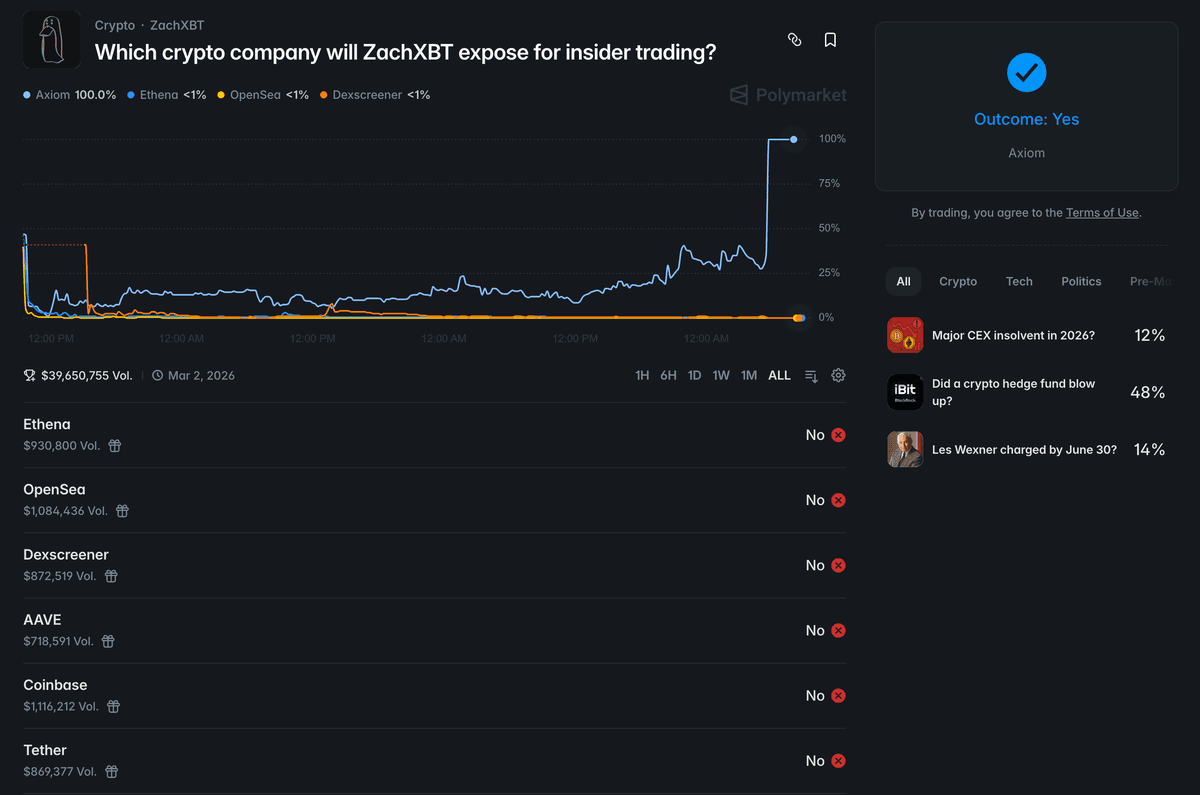
This post has been in my backlog for a couple months. Given the viral Polymarket market predicting which crypto company ZachXBT would expose for insider trading, I decided to publish this piece because I believe people would benefit from a more informed understanding of Axiom.

The real story of how Axiom was able to achieve such growth in less than a year since launch has not been told, as they are a discreet team and do not publicize much about the team, culture, or processes behind their product.

For context, the following is a timeline of the saga:

Monday, February 23 @ 07:57 ESTZachXBT tweets that he is publishing an investigation on one of crypto's most profitable businesses later that week
Monday, February 23 @ 12:30 ESTPolymarket lists the event, allowing people to trade which crypto company ZachXBT will expose for insider trading.
Thursday, February 26 @ 08:41 ESTZachXBT reveals that Broox Bauer, an Axiom employee, was one of multiple employees allegedly using internal tools to engage in insider trading.
Polymarket screenshot
ZachXBT tweet

Developments are ongoing and this post is not meant to serve as investigative journalism. Rather, it explores how a two-person team with no prior crypto experience broke into the industry, built the fastest company to $100M in revenue in YC history, and what their trajectory reveals about the shape of elite startups going forward.


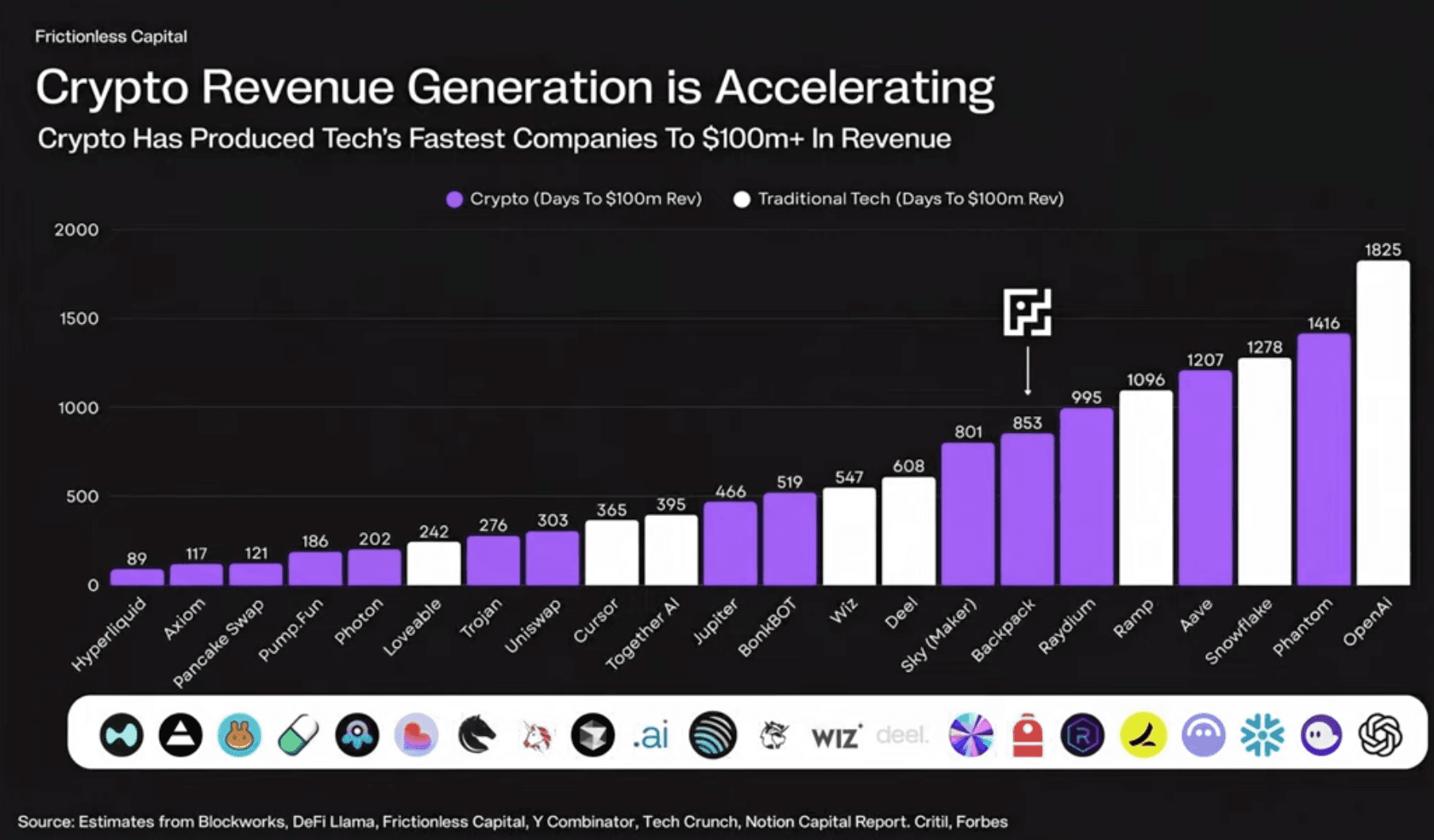
Axiom (YC W25) is a trading interface primarily targeted towards people trading long-tail tokens (polite term for memecoins) on Solana. Axiom was founded by two individuals and hit $100M in revenue in just 117 days. This is over twice as fast as the most hyped AI and financial applications such as Cursor, Lovable, and Ramp that consistently dominate headlines and mindshare.

Axiom revenue chart

Interestingly, one of the few public advertisements for Axiom is this campaign run by the Solana Foundation and a VC firm who isn't even on their cap table. The ads aim to legitimize crypto as a viable industry to prospective founders in San Francisco:

Axiom advertisement

Axiom represents a new company archetype: one that sits at the intersection of relentless focus, monetary incentives, willingness to enter competitive markets with mediocre talent, and a third-derivative product.

In this post, I explore how Axiom became the fastest YC company to $100M in revenue and one of the highest revenue per employee companies ever.

  1. Background on Axiom
       a. The Team Behind Axiom
       b. Axiom's Business Model
       c. Axiom's Revenue Numbers are Misleading
  2. Just Win: Inverting Consensus Advice
  3. Third Derivative Products
  4. AI Compresses the Insight-to-Execution Pipeline

Following this analysis, I provide commentary on Axiom and the shape of this company archetype moving forward.

1. Background on Axiom

The Team Behind Axiom

Axiom was started by two co-founders, Henry Zhang (ex-TikTok) and Preston Ellis (ex-DoorDash). Axiom has only raised capital from YC, and has not sold any more of the company.

Unlike other crypto teams who have historically sought to de-risk themselves by raising large seed and Series A rounds before launch, Axiom embodies the YC ethos of shipping, iterating, and talking to customers. Axiom ships and communicates frequent updates to their users via Discord and Twitter.

Axiom has since grown its engineering team in Austin to scale out its product. The majority of the core infrastructure has been built by Henry and Preston.

Axiom's Business Model

Axiom makes money by charging trading fees and selling order flow. [1] Like Robinhood and other traditional brokerages, Axiom is a frontend and does not own any of the underlying infrastructure.

Axiom currently processes $50M - $75M of daily volume. Trading fees are charged based on volume. Axiom charges 1% on every trade at execution. Depending on your account's volume, Axiom pays users back via a rebate, lowering the net effective fee. Their public cashback fee tiers range from 0.05% to 0.25%. This means that a user's net fee ranges from 0.75% to 0.95%.

For context, users trading US equities typically pay 0.05% (5 bps) or less per trade. Axiom is able to charge an order of magnitude more because memecoin traders are extremely price inelastic. Axiom users operate in an asset class with an extremely convex payout profile (users either expect assets bought on Axiom to increase in value by 10x or go to 0 within hours, sometimes minutes). Because of this dynamic, users are willing to pay high fees for a best-in-class user interface and trade execution.

By default, trades on Axiom are sent with 20% slippage (the majority of users do not change this setting). This means that the user is willing to accept a 20% worse price if it is able to be executed. If an asset has a notional value of $100, users express a willingness to accept $80 as long as they can buy or sell the asset. While slippage theoretically works both ways, users almost never receive positive slippage (receiving more than they initially anticipated). Positive slippage is typically captured and retained by a sophisticated party at some point in the supply chain.

Like Robinhood, Axiom also makes money from selling user order flow (PFOF). Axiom's order flow is extremely valuable because it is non-toxic (originates from normal retail users) and high volume. The majority of the order flow is being sold to Temporal, a Solana-native research and trading firm founded by individuals with backgrounds from Citadel and other traditional trading firms. Axiom routes order flow to Temporal, which is responsible for actually executing the order flow. Temporal abstracts the execution complexity of actually landing the transaction on-chain for developers. Running infrastructure to execute order flow is a highly competitive business in crypto with high technical, operational, and economic barriers to entry (large amounts of tokens are required to run validators).

The entities that Axiom sells order flow to are responsible for executing the order flow in the same way that Citadel is responsible for executing the order flow on Robinhood. PFOF, implemented correctly, increases user welfare, as users receive better prices. However, in the unregulated crypto arena, the little to no oversight by any regulatory committee has translated into recurring abuse of users. While Robinhood users enjoy price improvements from order flow segmentation, Axiom users often get maximally exploited by actors throughout the supply chain.

Axiom's revenue numbers are misleading

Axiom's business model of charging 1% upfront and variable rebates leads to misleading numbers. Charging someone $100 but immediately giving back $50 should not be marked as $100 of revenue.

Axiom's documentation site outlines the variable cashback tiers based on trading volume. However, this is misleading as select large and early users have non-public side-deals with Axiom that increase their cashback rate.

Many of their early users are receiving 50%+ cashback for an effective fee of much less than 0.50%. Because trading terminals like Axiom are so top-heavy (with a few users generating much of the volume and fees), Axiom's top-line $100M revenue metrics are an overestimate.

Axiom's public revenue numbers do not include additional revenue from selling order flow to Temporal. While the details of that arrangement are non-public, this is likely in the high seven-figure range depending on volume.

Because Axiom's business has many obfuscated components, it is difficult to accurately assess their top-line revenue from an outside perspective.

2. Just Win: Inverting Consensus Advice

The consensus VC view is that one should only invest in companies with structural moats, or at least in companies with a clear pathway to creating one. They believe that moats are a necessary component of great companies because they allow companies to operate as a monopoly, enabling them to extract rent via their differentiated products and services. Companies that operate in competitive markets have no structural moat and are viewed as uninvestable and low status.

Ceteris paribus, one would much rather operate a company with a structural monopoly on some product or service. However, most people do not have the technical capabilities or social capital to have a real monopoly. If a company is telling you that it operates a monopoly, they almost certainly do not.

Barring extreme outliers, the sharpest college graduates are incapable of creating a durable monopoly business. Building a monopoly business requires high context, a specific thesis, and political intelligence that requires many years of networking and life experience. This has led to many top graduates chasing empty prestigious titles and careers. No one is really working.

In this world of status-chasing and people losing the plot, actually talking to end-users has become a moat in itself. While anybody can do it, it requires interacting with people many see as below their social status. This has led to many influxes of people only wanting to build companies where they are only selling to people they can bear to interact with (B2B, typically selling to engineers at other companies), if they even talk to customers at all.

Axiom inverted this advice and consciously entered an established market, outcompeting the existing players:

  • Built a company in crypto with strong engineering and product backgrounds, where the talent bar is low due to crypto's deserved reputation for scams.
  • Entered the memecoin space, a sub-sector of crypto with some of the lowest talent and integrity levels across tech. Many competitors did not have traditional Silicon Valley experience and lacked the institutional knowledge of how to build applications. Furthermore, many early memecoin developers got rich from the previous wave of memecoins and checked out, leading to significant adverse selection.
  • Built a frontend, a thin layer around existing infrastructure and protocols with effectively zero barriers to entry and pulls from a global talent pool.
  • Entered the game late (post-Trump election in 2025) when there was sufficient market demand and existing products were already generating millions of revenue (Photon, BullX, BONKbot).

Axiom brought Silicon Valley product experience to a set of users willing to pay high fees. Much of their initial growth can be attributed to just doing the basics: focusing on a niche, talking to users, and rapid product iteration. They penetrated the few high-volume Telegram trading groups that matter, scaling via word-of-mouth and a referral program with Axiom-watermarked graphics.

3. Third Derivative Products

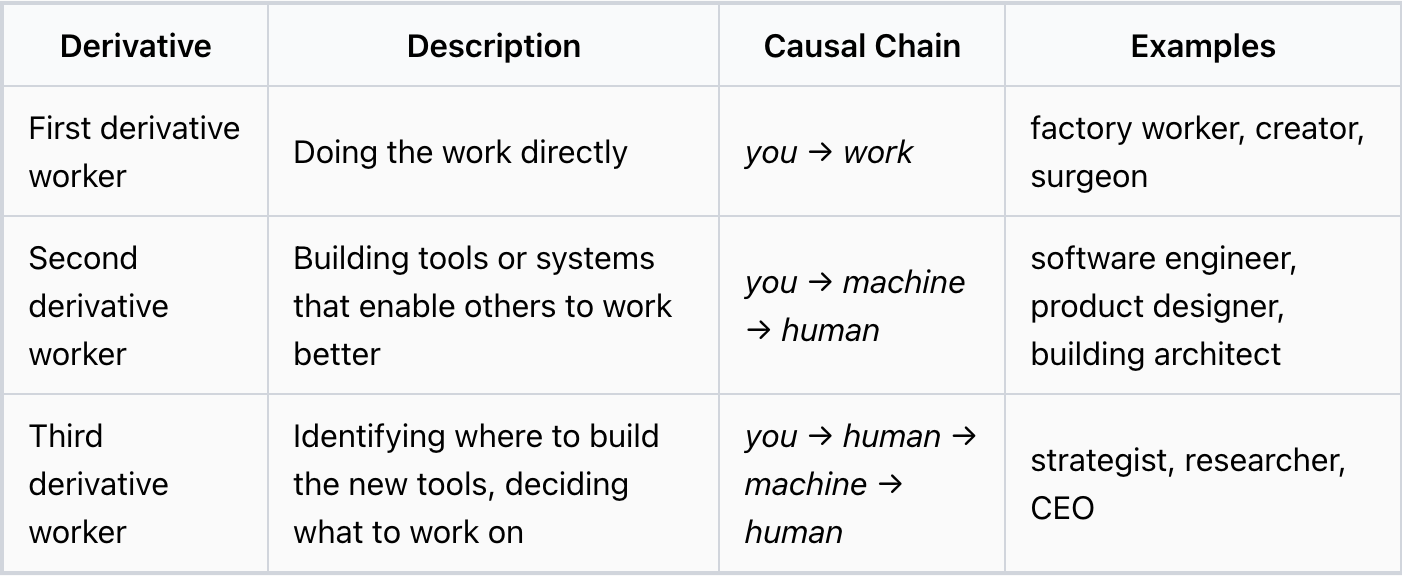
In a previous post, I outlined a theory of "derivative levels" as a way to understand why certain roles and types of work are highly compensated.

Derivative levels diagram
2025-12-02

A Retrospective on 30 Days of Daily Blogging + Updates

Onwards


If you're reading this on Substack or over email, you probably thought I took the month off. But you would be wrong!

November was actually my most prolific month of blogging. Before November, I published 13 posts in total. I published 30 blog posts in November alone, over double what I had achieved over the course of the previous nine months.

Logistics

All posts are live and available on humaninvariant.com. You may have seen some posts already on MR and HN.

Across the next month, I will be posting select posts from the past 30 days to the Substack mirror and the mailing list. Others will be published to the Substack mirror without a post notification.

Retrospective

I published 28,427 words by posting every day over the course of November. Some topics I covered include:

  • Third derivative work (building off of No One is Really Working)
  • The negative externalities of agency-maxxing "you can just do things" posts
  • Blame as a Service
  • Prediction markets
  • the lowercase aesthetic
  • Why are conversations and my productivity better late at night?
  • The market microstructure of YouTube
  • Observations from in person interactions with successful bloggers
  • Understanding the scale of the internet

To be sure, not all posts I wrote during this stretch are good. Some days I really did not want to write, and likely would have quit without external pressure. But I learned just how good of a forcing function publishing a post every day is. It enabled me to explore more ideas than a typical month of one or two posts, and now I have many more ideas I'm excited to explore.

Many of these posts were specifically enabled by being in person and talking with other people I had never met before. I spent the month with people who have been thinking about prediction markets for years, including someone who ran internal prediction markets at Google in 2017 and an academic who was an early author of many prediction market papers.

2025-11-30

On Learning Through Presence

Connecting the invisible dots


When you encounter someone's final work product, whether it is a blog post, a tweet, or code, the only legible thing is the polished result. The million inputs that go into the end result are invisible to the end user.

The illegibility prevents you from seeing the countless intermediary drafts, weird quirks, and rituals that enabled the final work product to come to fruition. The illegible inputs are an amalgamation of a rich contextual history that is only learned offline, in person.

Physical presence exposes the illegible because it gives you access to people, and people are the generators of culture, systems, truths, and opportunities. The real updates to your life don't come from reading words online, but rather from being exposed to stimuli in the real world.

Culture

When you show up in person, you feel like you don't belong. You quickly learn that others have a deep and rich shared cultural history that has spanned over the better part of a decade, while you are a newcomer. You try your best: you connect with people during late night conversations you would have never connected with otherwise, and maybe even plan to throw a joint party together in New York.

You learn via oral history that you are standing in a place that was going to be turned into a soulless Marriott for consultants, but somebody cared enough to prevent that from happening. You learn that even the most rational people operate under the same universal constraints as you.

People

You learn about the entire production function of others and what makes them tick: from the conversation topics that pique their interest even well past midnight to how they take their coffee. You notice that one person always sits at the same outdoor table facing north, how impervious some are to the cold, and how many Diet Cokes people are drinking well past 9 pm. You learn that one of the leading social psychologists has a sick Ness. You learn about the Cosmic Crisp industrial complex, the only good thing to ever come out of Washington State.

Systems

You learn that these same dynamics are present in blog posts, which turn into movements, companies, and political change. You learn the shape of successful people: some of them are nicer and some are meaner than you could have imagined. Some completely strip away the Straussian veneer while others continue to talk in coded messages with multidimensional meanings.

2025-11-29

Scale of the Internet

Inspired by Scale of the Universe


Posting on the internet compresses your audience to a number on a screen. Just like compound growth, our brains are not well equipped to contextualize the relative size of these numbers.

In this post, I attempt to provide a better intuition for contextualizing audience sizes across orders of magnitude, using visualizations and anecdotes.

Following the contextualizations, I provide reasoning for why our inability to fully grasp audience scale is precisely what makes it possible to create authentic work on the internet.


2025-11-28

The Era of Data-Driven Ideas

Legibility creates velocity


Anthony Lee Zhang categorizes ideas into two types:

  • Idea-driven ideas: an idea where you start off with a high-level philosophical frame and deduce a concrete insight using logical reasoning
  • Data-driven ideas: an idea derived from pure data with no preconceptions

Building on this framework, industries can be characterized as idea-driven or data-driven.

Idea-driven industries:

IndustryReasoning
Early-stage venture capitalLimited data on unproven startups creating new markets
Traditional economicsA macro-level assumption about markets (e.g. markets are efficient) leads to various downstream conclusions
Policy-makingFrequently shaped by ideological principles before empirical testing
Brand marketingOften relies on intuition about cultural trends and human psychology

Data-driven industries:

IndustryReasoning
Private equityPotential LBOs are modeled on a spreadsheet; if the investment is able to clear a given hurdle rate, then the investment is "good"
Quant tradingStrategies are thoroughly backtested against historical data
InsuranceRisk is quantified via actuarial tables.
Growth engineeringFeatures are A/B tested until a local maximum is achieved
PokerComputer solvers determine exact EV for every decision

Similarly, movements can be categorized as primarily idea-driven or data-driven.

Idea-driven movements:

MovementReasoning
Civil RightsAll people are created equal, segregation is inherently unjust
CryptoProperty rights should be digital-native, censorship resistant, and permissionless.
LongevityDeath is a problem to be solved, not an inevitability to be accepted; aging is a disease rather than a natural process

Data-driven movements:

MovementReasoning
Progress StudiesCompounding economic GDP growth is the most important factor to increase human welfare
Climate ActivismIf global temperatures increase by more than 1.5 degrees Celsius, it will cause irreversible negative externalities
Effective AltruismMoral obligations and contributions can be quantified, and therefore optimized through utilitarian frameworks

Enabled by technology, data-driven ideas operate at higher velocities than their idea-driven counterparts across industries and movements. Data-driven ideas are not more rigorous in nature, as evidenced by the many industries and movements built on falsified data.

In this post, I outline how the legibility of data-driven ideas creates coordination, which in turn, creates velocity.

2025-11-27

Ideas to Incentivize and Scale More Blogs

Scaling new blogs and alleviating blog decay


In my last post, I outlined possible explanations for the decline of the blogosphere and the market forces that compete to prevent another golden era of blogging.

While I think that the current equilibrium of the diffusion of bloggers creating a set of active practitioners is a better allocation of human capital, I recognize that this is hypocritical as I am a direct beneficiary of the broader blogosphere. I did not enjoy university and was not on a path toward social and intellectual fulfillment. At the right moment of my life, I discovered the broader blogosphere network, which enabled me to engage with ideas in a way that school never clicked for me at school. Most importantly, it provided me with a network of earnest peers and mentors that provided the substrate for confidence and courage, and growing my ambition at a critical point in my life.

Much of this can be attributed to the fact that the blogging community is made up of an incredibly small number of extremely generous and earnest individuals. Capital and time are viewed as sharable resources to invest and bestow upon the next generation. While most institutions and other aspects of life are typically very antagonistic and transactional, the blogging community provided one of the first glimpses into a culture that can make a legitimate claim to be earnest and positive-sum.

The handful of people provided mentorship and capital that definitively changed the course of my career. Many of my friends and other bloggers have had similar experiences. All of us are eternally grateful to our friends and benefactors who enabled us to chart a different path in life beyond the default life trajectory. These people, some of whom I met because I read their blogs growing up, acted as our omniscient entity. They showed us firsthand what it takes to be great at something, raised our aspirations, and made the right connection at the right moment in our lives. More blogs would enable more people to have similar experiences.

In this post, I provide multiple tested and untested mechanisms to incentivize new blogs and help existing blogs scale.

Incentivizing New Blogs: 0 → 1

The barrier to entry for bloggers is effectively zero. Infrastructure is free via platforms such as Substack. Most of the time, bloggers are stuck in the valley of believing they have nothing interesting to say or don't think the opportunity cost is worth it.

The following are steps to incentivize the creation of new blogs:

  1. A richer culture of encouragement around starting new blogs to provide an easier on-ramp.

More new blogger Slacks, core meetup czars in different cities, etc.

2025-11-26

Where is the blogosphere?

Decline or diffusion?


The blogosphere was a loosely connected group of bloggers that peaked in the early 2010s, with a core focus around economics. Infrastructure was maturing, ideas were flowing, and core blogosphere members became close friends offline. While the community still loosely exists today, it does not carry the same intellectual weight or draw the same level of talent as it used to.

The blogosphere attracted a certain archetype that was overwhelmingly interested in ideas and willing to argue about a variety of topics with random strangers on the internet. Because of the blogosphere's centrality and small size, a formal status kingdom among internet intellectuals naturally emerged and a network effect around the blogosphere developed.

Scott Sumner described the distinction between "blogosphere economics" and "academic economics" as:

To me, the term 'blogosphere' sounds dumber than 'academic,' even if you didn't know the meaning of either term. Say them both out loud. I'd prefer "the ungated, free entry, merit-driven, competitive, methodologically eclectic, wisdom of crowds-based global hive mind," vs. "ivory tower, methodologically dogmatic, elitest, academic world where you either data mine to publish empirical papers or invent endless permutations of theoretical models.

The blogosphere was one of the primary intellectual counter-cultural movements that legitimized internet-based discussion and science. There is still a long way to go but there are clear signals that the tides are turning:

  • SlimeMoldTimeMold are mad scientists trying to solve obesity via a terrific series on how to run one-person studies.
  • Aella is a scientist and sex worker running one of the most comprehensive datasets in human history, contributing to our understanding of relationships and sex with novel data-driven insights.
  • Adam Mastroianni, a Harvard social psychology PhD, choosing to not work in academia, electing to run a Science House for researchers to live together and work on science, while also writing a Substack.

One by one, elite talent is being vampire attacked into the ungated, free entry, merit-driven, competitive, methodologically eclectic, wisdom of crowds-based global hive mind. But while internet science begins to gain legitimacy and solidify, the blogosphere that spawned them has been on the decline.

The blogosphere decline

Since its peak in the early 2010s, the blogosphere has largely faded away due to some combination of the following factors:

  • Social media: Twitter offered higher engagement, more career upside, and more universal status markers for a fraction of the effort. Why spend three days crafting the perfect 2,000-word blog post when you can pump out 280 characters every time you take a shit?
  • Stagnation in blogging market microstructure: besides Substack, which started in 2019 and provides infrastructure to deliver posts directly to inboxes along with a monetization layer, nothing else has changed. Existing blogosphere participants were already plugged into RSS feeds, meaning that there was little expansion of the scene.
  • Higher opportunity costs: The 2010s were a decade-long bull market, where people rationally chose to become a practitioner over a Straussian internet blogger.
  • "Real jobs"
  • Kids